Showing posts with label Presidents of Saint John's University. Show all posts

Wednesday, April 27, 2011

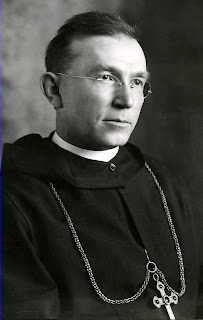
FIFTH PRESIDENT—Alcuin Deutsch


Father Alcuin Deutsch was elected the fifth abbot of Saint John's Abbey on December 29, 1921. He had served as prior during Abbot Peter Engel's last four years and showed a talent for administration। He was to serve as abbot for twenty-nine years, until his resignation because of failing health in October 1950.


In many respects he was the epitome of abbatial authority. As a young monk he had spent six years at the Colegio di Sant' Anselmo, the Roman headquarters of the Benedictine order. He made friends with European monks of his own age and visited communities like Maria Laach and Beuron in Germany and Maredsous in Belgium where monastic observance had been renewed following centuries of religious and political turbulence. Those years shaped his notion of what Benedictine life should be like.

He doesn't appear to have entertained any doubts on that score from the moment he assumed office. On becoming abbot he instituted a daily horarium structured around the Hours of the Divine Office, the daily Eucharist, and the common table from which no one was excused except those unavoidable absent to carry out assigned tasks elsewhere. (Those assigned tasks elsewhere included the large number of ordained monks and some brothers who were stationed in parishes or missions distant from the abbey.) He had a short form of the Divine Office in English prepared for the brothers to replace the devotional prayers in a mix of German and English that had been the mainstay of their common prayer from the early days when few of them had much schooling.

"Vacation" was not a word in Abbot Alcuin's dictionary. Going off-campus for entertainment or dinner was unheard of. Radio was just becoming popular; Alcuin regarded listening to the radio as a pernicious habit. He frowned on cigarettes. Cigars were approved; he could appreciate an occasional Italian cigarillo. Once Prohibition was repealed the abbey purchased a load of grapes annually to make a raw red wine that was served at table on Tuesdays, Thursdays, and major liturgical feasts. There was a beer at table on the Fourth of July.

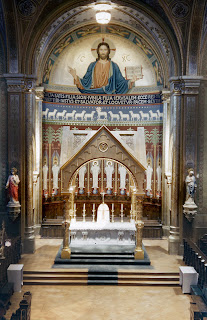
With a traditional sense of missa et mensa--Mass and meals--as the cardinal community activities, Abbot Alcuin had the church sanctuary re-done in Beuronese style with Brother Clement Frischauf's Christus Pantocrator in the apse.

The monastic refectory was paneled in oak with monochrome murals by Brother Clement depicting monks at work and prayer. The paneling and the heavy oak tables and chairs designed by Father Raphael Knapp and still in use came from the Saint John's woods by way of the abbey sawmill and woodworking shop.

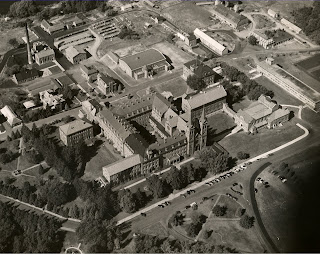
Saint John's flourished under Alcuin's direction। One of his first actions was to restructure the academic apostolate chartered as a seminary in 1857 and styled a university by legislative amendment in 1883। On becoming abbot, Alcuin divided the university into a preparatory school, a college, and a a four-year major seminary, each with its own dean serving under him as president। Benet Hall, the first college residence separate from the Quad, was completed during his first yer in office. The auditorium (1928), power house (1945), and diocesan seminary (1950) were the other major construction projects of his tenure. The farm produced much of the food for monks and students: vegetable gardens, orchards, dairy herd, hog farm, chicken house, butcher shop, mill. The German Franciscan Sisters contracted by Abbot Peter continued to do all of the food preparation for monks and students--including 30-gallon jars of sauerkraut--throughout Alcuin's years as abbot.

Early in his abbacy he encouraged Father Virgil Michel's interest in the European revival of the liturgy , gave him the time to travel in Europe and get to know the leaders of the liturgical movement there, then return to Saint John's and in one climactic year, 1925-1926, found the Liturgical Press and the monthly liturgical periodical, Orate Fratres, gathering around him a cluster of other monks in the prime of their careers as preachers, writers, teachers.


In his twenty-nine years as abbot, Alcuin sent 102 monks away for advanced studies, among them Godfrey Diekmann, who was to be Virgil Michel's successor and a peritus on liturgical renewal at Vatican II। Alcuin wanted the college to be good but small. He thought monastic communities and schools could get too large. He resisted what he thought of as the intrusion of secular education standards and only reluctantly consented to seeking accreditation in the late 40s.
For three decades he assisted one struggling monastic community after another by sending monks from Saint John's to help out. He built up Saint John's mission in the Bahamas as a thriving apostolate. The monastic community kept growing. It numbered 168 in 1921, 288 in 1950. After World War II, Abbot Alcuin started spinning off new missions to Mexico, to Puerto Rico, to Japan, to Kentucky. In the Bahamas he formed a priory and a secondary school, St. Augustine's, which continues to flourish under lay direction.


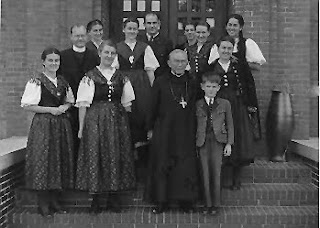
Abbot Alcuin poses with the von Trapp family singers on their visit to Saint John’s in 1947

Alcuin was an extraordinary abbot because of the breadth of his vision, his intelligence, and his fearless dedication to what he saw as monastic principles. He was not unkind, but his word was law. In 1945 he stopped newly ordained Father Herman Wind in the corridor after breakfast and told him he was to go to the Bahamas to join the other monks there. This was Herman's first indication of what turned out to be his life mission. Abbot Alcuin didn't invite the young monk to come in and talk about it; he simply told him to go. Writing his memoirs forty-three years later, Herman said the abbot's decision to send him to the Bahamas came as a cruel disappointment; he had entered the monastery in the hope of serving in his home parish, Saint Bernard's in St. Paul. Looking back in retirement, he was grateful for the direction his life took because of Alcuin's confidence in his ability and his sense of obedience. More than any of the other past abbots of Saint John's, Abbot Alcuin Deutsch lives on as the local archetype of the wise and prudent master Benedict envisions in his rule for monasteries.
Friday, December 11, 2009

THE FOURTH PRESIDENT, ABBOT PETER ENGEL, A MAN OF THE EXTREME CENTER


Peter Engel was a boy of 13 when he started classes at Saint John’s College in September 1869. His parents had moved from his native Wisconsin to St. Michael, Minnesota, a few years earlier. By his own account they sent him to Saint John’s because he didn’t like farm work but showed some aptitude for studies. “I had at that time no clear idea about my vocation,” he wrote later (qtd Barry,Worship and Work, 224).

Four years later—“not before Christmas, 1873” he says as though it were a point of contention—he made up his mind to join the Order. He was sent to St. Vincent Abbey in Pennsylvania for his novitiate year, July 1874-1875, and stayed on a few months longer to study physics and chemistry. Apparently that was the extent of his graduate education in science. Years later he would send Anselm Ortmann to Johns Hopkins for advanced work in physics, the first of many Saint John’s monks to be engaged in graduate study in the new century.

He was elected abbot in 1894 and continued in office until his death in 1921. Like his predecessors Alexius Edelbrock and Bernard Locnikar he kept the title of college president while designating a vice president to carry out administrative duties. All the rest of his career would show that he was a born educator with particular interest in scientific fields. Colman Barry says that of Saint John’s early abbots he was the one most interested in developing the school (226).

“He had studied and taught natural philosophy, physics, and chemistry; developed a physics laboratory; opened a meteorological station . . .; installed a wireless telegraph station . . . ; and opened an astronomical observatory on top of the water tower” (226).

He had the buildings wired for electric light in 1898. On October 10 the current came on, generated by a new dynamo in the power house. “The study-halls were now brilliantly lit up by dazzling clusters of lamps” (Alexius Hoffman, St. John’s University: 1857-1907, 119).


The 1901 library with St. John’s Photo Studio on the third floor.

Half a dozen campus buildings of little architectural distinction, all of which are still in use, sprang up in a loose configuration behind the Quad in the first decade of the twentieth century: a combination library/music department/photo studio, now Wimmer Hall (1901), a gymnasium, now Guild Hall (1901), a residence for the Franciscan Sisters who staffed the kitchen for fifty years, now St. Francis House (1904), an infirmary, now Greg House (1907), a science building, now Simons Hall (1910).

A charming edifice that no longer stands was the brick observatory constructed according to Peter’s design in the summer of 1894. It stood on the high ground east of the Quad but was razed in 1961, a few years before word of historic preservation reached Collegeville, in order to clear the site for the Prep School.


Completed in Peter Engel’s first year as abbot, the observatory had a seven-inch telescope and a revolving dome.

Abbot Peter was keenly interested in photography. He took the lead in documenting his era on glass plates that now constitute an invaluable archival record.

Enrollment doubled during his term in office and was gradually separated out into standard American levels—high school, college, seminary—although not yet labeled as such. In 1894, the year before he took office, enrollment in the ecclesiastical course stood at 39, the other levels at 199. In 1921, the year of his death, there were 59 students in what was now called the School of Theology and 400 students in the academic, collegiate, and commercial departments.

Intercollegiate athletics got its start while Abbot Peter was president. Saint John’s joined six other colleges to form the MIAC in 1920. The 1920-1921 catalog announced that “the purpose of this conference is to foster at its highest the spirit of intercollegiate friendliness, which is so important a factor in giving athletic rivalry its proper educational value” (87).

In this 1912 view the Gymnasium and the new Science Center stand North of the Quad.

Peter Engel was admired and loved for his personal warmth and fair-mindedness in spiritual and pastoral matters as well as education. A man of the extreme center, Colman Barry calls him, quiet but firm (225). His twenty-six years of rule followed by Alcuin Deutsch’s twenty-nine years provided the guiding principles and the steady direction that shaped the Saint John’s we know today.

Wednesday, November 4, 2009

SECOND PRESIDENT, SECOND ABBOT, EMPIRE BUILDER

Alexius Edelbrock

In his centennial history of Saint John’s, Worship and Work, Father Colman Barry refers to Abbot Alexius Edelbrock as an empire builder. He notes that John Ireland, newly appointed coadjutor bishop of St. Paul, came to the formal blessing of Alexius as abbot on October 24, 1875, and that “the fascinating careers of Minnesota’s two ecclesiastical ‘empire builders’ were thus initiated in that same autumn of 1875” (132).

Alexius was 32 when he was elected abbot. He had been appointed president of Saint John’s College three years earlier. He kept the job, explaining to Abbot Boniface Wimmer in Pennsylvania, “I do not even have anybody to run the college and the whole task devolves upon me” (qtd. Barry, 132). To “run the college” he invented the office of vice president and appointed Father Chrysostom Schreiner to fill the post. His successors continued this arrangement until 1922 when the fifth abbot, Alcuin Deutsch, reorganized the school as preparatory school, college, and seminary, each headed by a dean.

He was a local boy, born in Westphalia and brought to this country by his parents, Anton and Christiana Edelbrock, the first German settlers in St. Cloud. He was one of five boys who started classes at the new Benedictine college on the banks of the Mississippi in November 1857. His description of the experience is unvarnished: “There was poverty everywhere; a poor and miserable house, poor and scanty food; poor and bad lights. The tallow candle was the only light in those days. . . . We had few books. The Professor lectured, we had to write. Yes, we were started in on the European plan” (Barry, 58).

He was abbot for fourteen years, then was forced to resign by discontented members of the monastery supported by John Ireland, now archbishop of St. Paul. Colman Barry relates the story of malicious troublemakers and overbearing ecclesiastics with considerable relish but with ultimate sympathy for the wronged abbot.

In his fourteen years Alexius had given Saint John’s its permanent identity. Partly this was a matter of names. When the community achieved abbatial status in 1866 the abbey was named St. Louis on the Lake in honor of Ludwig I of Bavaria, but the school was already known as Saint John’s College. People found two names for the same place confusing. In 1880 the abbot decided to retire St. Louis and dedicate the whole institution to St. John the Baptist.

Three years later he prevailed on friends in the legislature to move an amendment changing the title of the school from Seminary to University, a change regarded as pretentious by some of the monks and lampooned in the German language Catholic weekly, Der Wanderer.

Alexius was untroubled by his critics. He had a frontier zest for grandiose gestures. In 1879 he conferred pontifical doctoral degrees in philosophy and theology on three of his monks in virtue of a papal brief granted at his request the year before. One of them, Bernard Locnikar, who was to be the third abbot, declined the honor out of sheer embarrassment.

Bernard Locnikar


“Collegeville” became a name for Saint John’s when Alexius got James J. Hill to locate a train stop on the corner of abbey land intersected by the railroad. The stop was named Collegeville Station and a U.S. post office was built across the tracks from the station. The name was to outlast the railroad.

Abbot Alexius also gave Saint John’s the Quad. He inherited the brick front constructed in three parts—south wing, main building, north wing—between 1868 and 1873. To it he added the church, now the Great Hall, in 1882, and extended the structure to form a quadrangle (1886) that some of the monks thought vastly overbuilt for this rural outpost.

The Quadrangle 1886

He insisted on use of the English language in monastery and school. The Record, the school paper, began publication as a monthly vehicle for student writing in 1888. Acquisition of a printing press, used and not in very good condition according to Alexius Hoffmann, chronicler of the era, followed in 1889.

Colman Barry summarizes growth during Abbot Alexius’s tenure:

Beginning with a religious community of fifty-two members, by 1889 he was heading a Benedictine family of fifty-seven priests, ten clerics, thirty-seven Brothers and thirty-two scholastics. Enrollment in the school had increased from 183 to 350. The monastery was caring for forty-five missions of which he had inaugurated thirty-five. (163)

When Alexius was forced out of office in 1889 he found a patron in Archbishop Corrigan of New York, who gave him land for a parish that could become a monastic foundation with the provision that Saint John’s Abbey also accept responsibility for a Catholic mission to the Bahama Islands. The new abbot, Bernard, wanted nothing to do with responsibility for the Bahamas but he was generous in supporting his predecessor and supplying priests for the new parish, St. Anselm’s, which would be swallowed up in the South Bronx in Alexius’s lifetime.

There Alexius proceeded to build a cavernous four story rectory large enough serve as the residence for a new monastic community and planned a large church in the Byzantine style. Only the basement of the church was built before his death in 1908. The church was completed in 1916 and is cited in the November 5, 2009 New York Review of Books as “one of the finest examples of the medieval revival in America” (43). Alexius would not be surprised at the compliment. He always thought big.


Tuesday, October 13, 2009

THE FIRST PRESIDENT


Father Wolfgang Northman (1842-1876) was appointed president of Saint John’s College in 1867 for a five year term. The college had been chartered ten years earlier as St. John’s Seminary but had continued to enroll students year by year under the direction of whoever happened to be in charge of the small monastic community. Unlike the 1854 charter of Hamline University which included details of organizational structure and programs, the St. John’s charter merely named the officers of the corporation—president, secretary, and procurator (treasurer)—and provided that they should serve as its trustees.


When the first abbot, Rupert Seidenbusch, arrived from Pennsylvania in 1867 he immediately appointed Father Wolfgang president and inaugurated a building program. He found the entire community, monks and students, newly located at what was to be its permanent site on the high ground at the north end of the lake. Monks and students lived in a hastily constructed fieldstone house and two adjoining wooden structures taken apart and moved there from a temporary site more than a mile away through the woods.


Abbot Rupert called for brick yards on the property and projected a new two-storey brick residence 100 x 40 feet adjoining the stone house to the north to be completed in 1868. He also called for two more monks from Pennsylvania to bolster the faculty. In August he left for Europe on a begging tour and was gone until the following March.


When classes started in the fall Father Wolfgang found himself with fifty-two students and a faculty of eleven full and part-time instructors including himself. He had had all of his education at St. Vincent Abbey in Pennsylvania. His field was music but he also taught church history, Greek, Latin, mathematics, and bookkeeping. At the time of his death only eight years later it was noted that he was a fine organist and accompanied the choir on important liturgical occasions. The instrument would have been a harmonium; the first pipe organ at Saint John’s would be installed in 1891.


No year-by-year records of his administration survive but two milestone events stand out. In 1869 the school was authorized to grant college degrees and in 1870 the college published its first catalog.


The catalog was a dignified sixteen-page booklet printed by The Wanderer in St. Paul. One page sufficed to list the course of studies for the elementary school, the six years of the classical and commercial course which would eventually become separate high school and college programs, and the ecclesiastical course for seminarians. Naming the officers and the faculty took up three pages. Listing all ninety-four students—twelve seminarians and eighty-two college students—filled three pages. Nearly half the catalog, seven pages, carried an itemized list of premiums distributed at Commencement on June 28, 1870, for distinction in everything from Latin to elocution to bookkeeping.


Most entertaining is a high-flown and highly imaginative introduction describing the sylvan glory of this new Athens. After a boost for Benedictine education down the ages the writer gives directions about how to get to the place, eighty-six miles from St. Paul, all but the last twelve by the St. Paul & Pacific Rail Road. Effort to get to the “highly picturesque grounds of the College” is amply rewarded. The lake, six miles in circumference, abounds in fish. On the west side of the campus flows the Watab River, “beautiful in its windings through the valleys as the Peneus through the Thessalian Tempe of old.” If esthetic superlatives are not enough, it is good to know that “the location is undoubtedly one of the healthiest in the Union, as many who have regained health and vigor testify.”


Getting down to business, the school year comprises two five-month sessions, tuition and board is $90 a session, and students who make unusual progress may abbreviate the six years usually required to complete the Classical and Commercial course.


Wolfgang Northman completed his five-year term as president in 1872 and was followed by Alexius Edelbrock, who kept the title when he was elected abbot three years later and appointed a vice-president to direct the abbey’s academic enterprise. Father Wolfgang continued to teach music and do parish work until he died unexpectedly on a winter morning in 1876. He was the first monk to be buried in the abbey cemetery.


A view of the Quad in 1881

Tin-type of the framehouse